While there may be disagreements about whether Hammersmith Bridge should ever re-open to cars and buses, one thing that everyone making their voice heard about the bridge agrees on, is that something needs to be done to help the less able cross it.
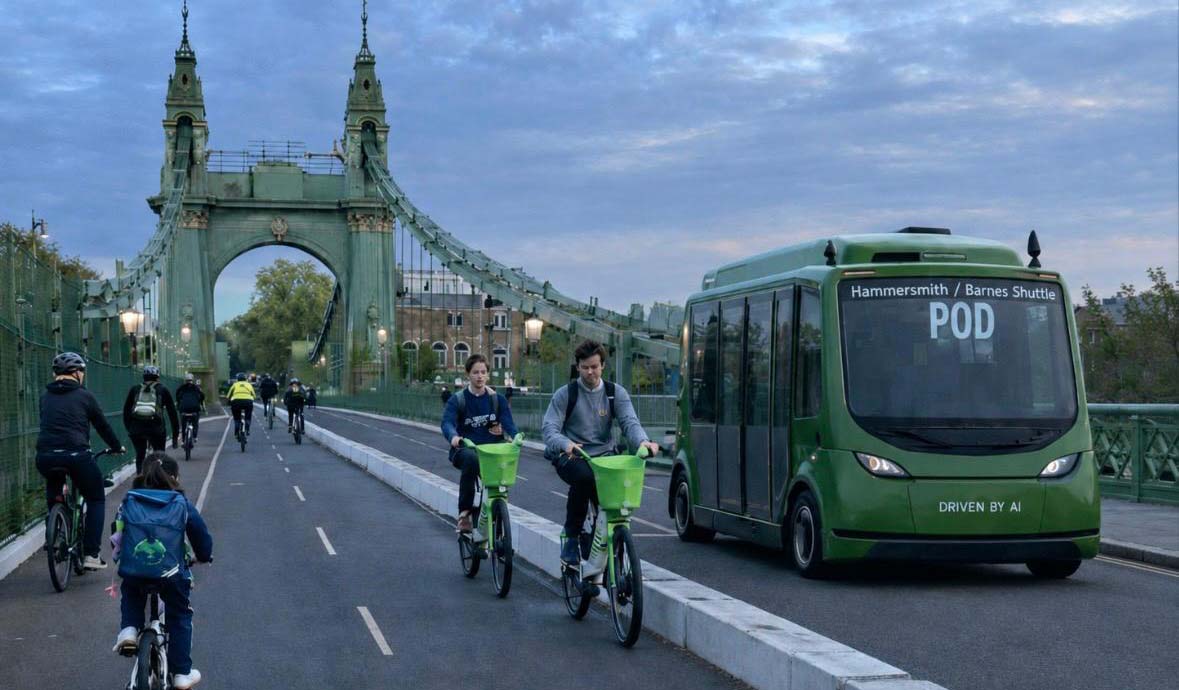
Charles Campion, a keen advocate of active travel and one of the progenitors of the Barnes Ponder, believes there may be an answer: driverless electric vehicles. He is part of a team of people that is setting up a not for profit Community Interest Company called Barnes and Hammersmith Electric Light Transit (BHELT) to build on an initial report by charity Possible in 2023 and explore whether autonomous pods could shuttle passengers across the bridge.
The new consortium, which includes representation from the Barnes Community Association and the Hammersmith Society, aims to open people’s eyes to different possibilities and to apply for a grant from the Centre for Connected and Autonomous Vehicles (CCAV) to fund a feasibility study.
The idea is that a fleet of small pods could carry people between the Barnes side of the bridge and Hammersmith, running from the Castelnau bus stops to the Tube and potentially Charing Cross Hospital. Subject to viable integration with the existing bus services, the pods could even serve Barnes village and other local destinations such as the Wetland Centre and Barnes station.
BHELT is working with the Milton Keynes based electric transit vehicle company Ohmio UK and together they will be bringing two pods to Barnes on Fair Day, Saturday 11 July, so that people can see for themselves what their proposed solution will look like.
It is an exciting idea, and Ohmio vehicles are already being trialled on the roads of Milton Keynes, so it’s not a pie-in-the-sky proposal. However, before it can become more than a great idea waiting to happen, many issues have to be resolved including weight, feasibility and responsibility.
Weight
The biggest obstacle is obvious. Hammersmith Bridge is still a damaged structure under tight safety controls, and even ambulances cannot cross under the current 1.5 tonne safety limit.
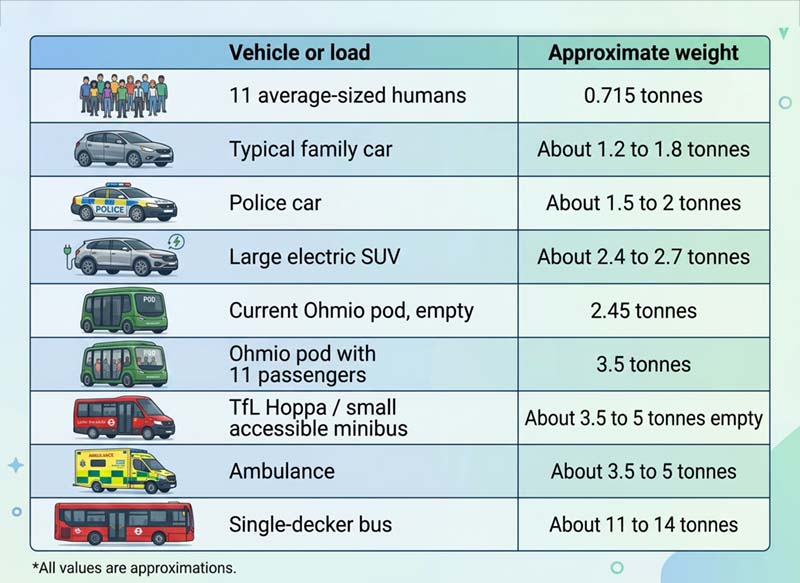
That matters because the Ohmio pods due to be shown in Barnes breach that limit. A published report on the model being brought to Barnes on Fair day says they weigh 2.45 tonnes empty and up to 3.5 tonnes fully occupied. For the Hammersmith Bridge project, BHELT’s work wth Ohmio will look at ways of making its pods lighter, although it would be quite a feat of engineering if the company could get them light enough to meet the current stringent limit.
Campion believes there may be room for movement in that limit, particularly in light of the stabilisation work already carried out. The BHELT team does not yet have its own civil engineering consultants and the consortium has not currently made a formal approach to the engineers responsible for the bridge’s ongoing safety monitoring – this would be part of the feasibility study work.
Feasibility
If the weight issue can be overcome, there is a long list of practical questions that a feasibility study would have to answer. The capital cost of the scheme, including an initial fleet of ten pods (initially estimated at £11m by Possible), maintenance and operating costs would have to be estimated and a place earmarked to store and charge the fleet of vehicles. Then, insurance, legal permissions and emergency procedures would need to be outlined, and the detailed loading implications of repeated crossings would have to be modelled. The autonomous nature of the pods brings significant savings in operating costs.
Responsibility
Then there is the question of who would run the service. Somebody would need to operate the vehicles, maintain them, keep them secure, manage safety, obtain insurance and carry responsibility if anything went wrong.
BHELT’s role is to put the idea into circulation, test public interest and seek support for a serious study, rather than present itself as a ready-made operator.
The answer as to whether the pods will be feasible is ultimately in the hands of engineers and operators. Supporters of the scheme could argue that the present restrictions are over-cautious in light of stabilisation work already carried out, but any shift would depend on those responsible for the bridge being persuaded that public safety would not be compromised. This is why a detailed feasibility study is hugely important.
With a fair wind, and support in the right places, the BHELT team believe it could take between two or three years for their idea to move from proposal to reality.
A Weighty Issue
Engineers considering the bridge’s weight limit don’t look at weight alone. In evaluating the feasibility of any form of transport crossing the bridge they will need to consider load distribution, braking, repeated crossings and the consequences of getting their calculations wrong – a worry that is perhaps the reason for the current abundance of caution in the 1.5 tonne limit.
To give Bugle readers some perspective on the bridge’s weight limit we’ve given a quick breakdown of the weights of different types of vehicles that might or might not in future cross the bridge.